
The short answer
Eight strong apps, built around different planning problems.
PrepWeek is best for dinner-only weeks that include nights off. MealPrepPro is best for calorie and macro-led prep. Mealime is best for quick curated recipes and grocery integrations. ReciMe is best for importing recipes from social platforms. Plan to Eat and Paprika suit people with established personal recipe libraries. Samsung Food offers the broadest ecosystem, while Cooklist is strongest when pantry and retailer data should drive the plan.
| App | Best when you want… | Price snapshot |
|---|---|---|
| PrepWeek | Dinner-only planning around the nights you actually cook | First plan free; Pro $7.99/month or $29.99/year in the US |
| MealPrepPro | Calorie, macro, fitness, and full-day meal plans | 7-day trial; auto-renewing subscription |
| Mealime | Quick curated recipes and grocery integrations | Free; Pro $2.99/month in the US |
| ReciMe | Importing recipes from social posts and the web | Free; US App Store lists multiple Plus in-app-purchase prices, including $39.99; confirm the current annual price on the listing |
| Plan to Eat | Planning from a personal recipe collection | $5.95/month or $49/year |
| Paprika Recipe Manager | Owning and organizing recipes without a subscription | One-time purchase per platform |
| Samsung Food | Recipe discovery, nutrition, and cross-platform breadth | Free; Food+ $59.99/year in the US |
| Cooklist | Planning from groceries already in a digital pantry | Free download; optional paid features |
How we compared them
A planning app should remove work, not relocate it.
We used first-party product documentation and current official pricing information. This is a documentation-based comparison, not a claim that we ran a long-term controlled test of every app. We assessed each product on the same six questions.
Where does planning start?
The week, nutrition goals, saved recipes, or pantry inventory.
Who chooses dinner?
The app, the user, or a mix of suggestions and control.
What becomes a list?
Whether planned recipes become one practical grocery list.
Does batch cooking fit?
How easily one cooking session can cover several meals.
What setup continues?
Accounts, imports, pantry upkeep, nutrition targets, and calendars.
Who is it not for?
The honest limitation that matters before downloading.
The apps
Choose by job, not by feature count.
Best for
PrepWeek
People who want the week’s dinners decided without calorie tracking, pantry maintenance, or a recipe-organizing project.
- Platforms
- iPhone
- Pricing
- First plan free; PrepWeek Pro is $7.99 per month with a 3-day trial or $29.99 per year in the US, with App Store pricing varying by region
Why it stands out
Choose the dinner nights first, including off-plan evenings, then pick batch-friendly recipes. Meal Groups can cover several adjacent dinner nights.
The trade-off
iPhone only; it does not import personal recipes, track calories, manage a pantry, or connect to grocery delivery.
First-party source: PrepWeek meal prep app.
Best for
MealPrepPro
People who want meal prep tied to calorie, macro, fitness, or nutrition goals across breakfast, lunch, dinner, and snacks.
- Platforms
- iPhone, iPad, and Android
- Pricing
- 7-day free trial, then an auto-renewing annual subscription; prices vary by country
Why it stands out
Personalized plans based on calories, macros, diet, allergies, dislikes, schedule, and household members. Supports cooking extra portions and choosing how often to cook.
The trade-off
Its health-goal and nutrition structure may be more than someone wants when the only job is deciding practical dinners.
First-party source: MealPrepPro overview and pricing, MealPrepPro plan creator.
Best for
Mealime
People who want quick, healthy recipes, detailed dietary filtering, and online grocery integrations.
- Platforms
- iPhone, iPad, Android, and web
- Pricing
- Free to download; Mealime Pro was $2.99 per month in the US when verified
Why it stands out
Build a plan manually or use an auto-builder shaped by diet, allergies, dislikes, serving size, and other filters. Can plan several meals and adjust servings, but the core experience is quick individual recipes rather than dinner-night Meal Groups.
The trade-off
The product covers a broader health and shopping workflow; users seeking a dinner-only, no-account planner may prefer something narrower.
First-party source: Mealime getting started guide, Mealime Pro features, Mealime App Store pricing.
Best for
ReciMe
People whose first problem is saving and organizing recipes from TikTok, Instagram, Pinterest, websites, or cookbooks.
- Platforms
- iPhone, Android, and a beta web app
- Pricing
- Free plan with up to five imports per week; ReciMe Plus includes a 7-day trial, and its US App Store listing shows multiple ReciMe Plus in-app-purchase prices including $39.99, so confirm the current annual figure on the listing
Why it stands out
Place recipes from personal Cookbooks into breakfast, lunch, dinner, or snack slots on a weekly calendar. Useful for scheduling saved recipes, but it does not center the plan on cook-once dinner groups.
The trade-off
Recipe collection comes before planning, so it can be more setup than someone wants when they need the app to help choose dinner.
First-party source: What ReciMe does, ReciMe meal planning guide, ReciMe free and paid plans, ReciMe App Store pricing.
Best for
Plan to Eat
Organized cooks who already have recipes they trust and want fine control over a reusable planning calendar.
- Platforms
- iPhone, Android, and web
- Pricing
- $5.95 per month or $49 per year on the official website; 14-day trial without a card
Why it stands out
Import and organize personal recipes, place them on a flexible calendar, and reuse saved plans. Flexible enough for batch planning, but the user designs the schedule and supplies the recipes.
The trade-off
It asks the user to curate and manage the recipe library instead of narrowing dinner choices for them.
First-party source: Plan to Eat product overview, Plan to Eat pricing.
Best for
Paprika Recipe Manager
People who want durable ownership and detailed organization of their own recipe collection without a recurring subscription.
- Platforms
- iPhone, iPad, Android, macOS, and Windows
- Pricing
- One-time purchase per platform; each iOS, Android, macOS, and Windows version is sold separately
Why it stands out
Add personal recipes to daily, weekly, or monthly calendars and reusable menus. Reusable multi-day menus can support a deliberate prep routine.
The trade-off
Paprika supplies tools rather than meal suggestions; the user still chooses, imports, and schedules everything.
First-party source: Paprika iOS user guide, Paprika platform and purchase information.
Best for
Samsung Food
People who want broad discovery, multiple platforms, nutrition features, or Samsung kitchen integrations.
- Platforms
- iPhone, Android, and web, with Samsung appliance integrations
- Pricing
- Free core product; Food+ includes a 7-day trial and was $59.99 per year in the US when verified
Why it stands out
Recipe discovery and saving plus weekly planning; Food+ adds tailored seven-day plans and templates. Plans and templates can organize a week, though batch-cooking is not the central model.
The trade-off
The breadth can feel like more product than someone needs for one calm weekly dinner decision.
First-party source: Samsung Food+ features and pricing.
Best for
Cooklist
US households willing to connect retailers and maintain a digital pantry to reduce duplicate buying.
- Platforms
- iPhone and Android, with US retailer integrations
- Pricing
- Free to download; optional paid features and regional availability may vary
Why it stands out
Recommend meals using groceries recorded in a digital pantry, then plan recipes and ready-to-eat products. Flexible meal planning, but pantry and shopping intelligence are the defining features.
The trade-off
It requires substantially more data and setup than a focused dinner planner, and its strongest retailer features are US-oriented.
First-party source: Cooklist app overview.
See the workflow
From an undecided week to one shopping list.
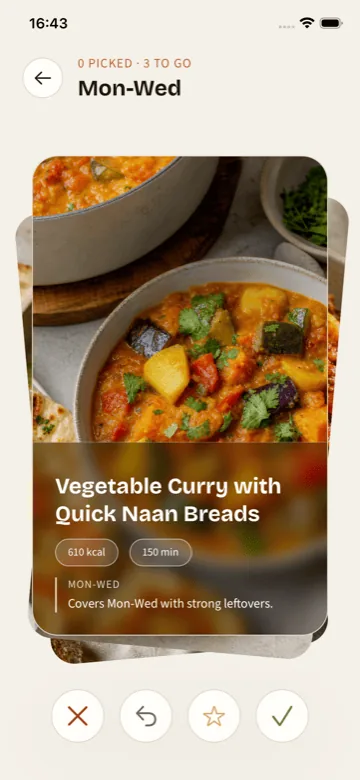
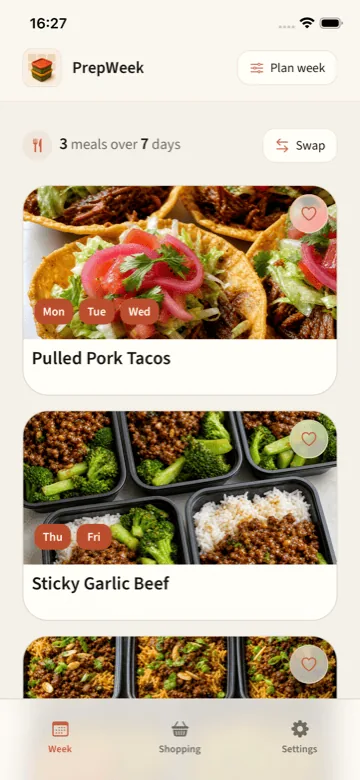
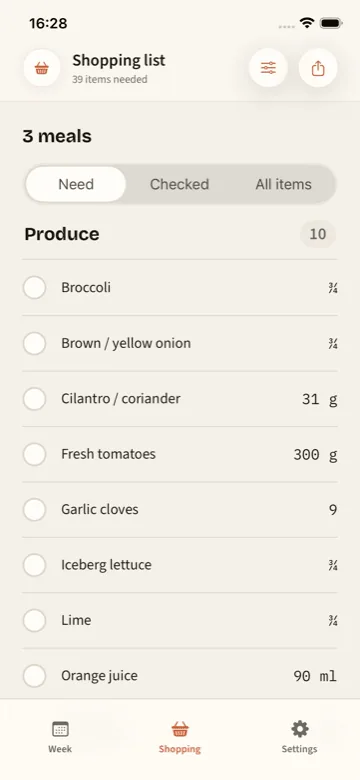
These are real PrepWeek screens. Pick the meals that fit, see how they cover the week, then shop from the list built from that plan.
Swipe to see all three screens →
First plan free. No account required.
Try PrepWeek on iPhoneCommon questions
Useful answers before you start.
What is the best free meal prep app for iPhone?
The best choice depends on the job you need done. PrepWeek lets you make your first plan free, while Mealime, ReciMe, Samsung Food, and Cooklist all have free starting points with different planning models.
Is there a meal prep app without calorie or macro tracking?
Yes. PrepWeek plans dinners without calorie or macro tracking, using Meal Groups to cover adjacent nights while leaving off-plan evenings alone.
Which of these apps work without creating an account?
PrepWeek needs no account for the first plan. Paprika only needs its optional Cloud Sync account when you want to use the same recipe library across devices.
Do these meal prep apps work for families or larger households?
Several do. PrepWeek scales recipes to household size, MealPrepPro can add a partner or family to a plan, Mealime adjusts serving sizes, and one Plan to Eat account can be shared by a household across devices.
Do these apps work in the UK?
Availability can differ by storefront, so check each app’s UK App Store listing on the device you plan to use. Prices vary by region, and retailer or grocery checkout integrations may vary by country.
How was this list of meal prep apps compiled?
We compared first-party product documentation against the same planning, recipe, grocery, batch-cooking, setup, and tradeoff questions. Read How we compared them for the method and First-party product documentation for the source links.
Decision guide
Which meal prep app should you choose?
I just need dinner decided
Start with PrepWeek if off-plan nights and batch-friendly dinner groups matter more than all-day nutrition.
I have calorie or macro targets
Choose MealPrepPro. Its planning model is built around those inputs rather than treating them as optional details.
My recipes are scattered everywhere
Choose ReciMe for social and document imports, or Paprika for detailed ownership of a personal library.
I want maximum planning control
Choose Plan to Eat when you already know what you want to cook and want a reusable calendar and list.
I want discovery and many platforms
Choose Samsung Food for breadth, especially if Samsung kitchen integrations are useful.
I want to cook from what I own
Choose Cooklist if retailer connections and digital pantry maintenance fit your household.
Related comparisons
Go deeper on the closest alternatives.
Sources
First-party product documentation
These sources support the factual feature, platform, and pricing statements above. Editorial fit recommendations are ours.
- PrepWeek meal prep app
- MealPrepPro overview and pricing
- MealPrepPro plan creator
- Mealime getting started guide
- Mealime Pro features
- Mealime App Store pricing
- What ReciMe does
- ReciMe meal planning guide
- ReciMe free and paid plans
- ReciMe App Store pricing
- Plan to Eat product overview
- Plan to Eat pricing
- Paprika iOS user guide
- Paprika platform and purchase information
- Samsung Food+ features and pricing
- Cooklist app overview